
Accident Report & Damage Documentation Berlin – When the Course of Events Is Disputed
This page is aimed at anyone who, after an accident in Berlin, needs not just a report but complete documentation from the accident scene to the finished report, for example if the course of events is disputed. If the question of fault is clear and you only need the report for the other party’s insurer, read on under accident report Berlin.
In short: If the other party disputes how the accident happened or there are no witnesses, a standard accident report is often not enough. For an accident report with damage documentation we also record the trace pattern, impact heights, vehicle positions and the sequence of events, so that a lawyer, insurer or court can follow what happened. This accident documentation for Berlin and Brandenburg therefore goes beyond a standard report. The fee is usually from 300 € to 700 €, for extensive damage from 700 € to 1,200 €; if liability is clear, the at-fault party’s insurer pays. If the Berlin police (German) recorded the accident, please give us the file number.
Table of contents
- A sensible order for collecting data after a collision
- Key images and precise assignment of damage
- Specific checkpoints on site
- Required vehicle and accident documents and passing them on to those involved
- If the other party disputes how the accident happened
- Frequently asked questions about the service
- Accident damage documentation in Berlin: from the accident scene to a complete file
- Clear documents for the next step in the claim settlement

A sensible order for collecting data after a collision
A structured order when recording data for an accident report in Berlin is crucial so that all relevant details are reliably available later. First, visible damage, vehicle position and accident traces are recorded; then technical data such as the chassis number, mileage and tyre pressure are documented. This is followed by witness statements, ambient conditions and the traffic situation. This sequence reduces the risk of overlooking key evidence and makes it easier to assign damaged parts and later prepare a traceable report that takes into account all aspects relevant to reconstructing the accident and assessing the damage properly.
You can find out more about our work as a motor vehicle assessor in Berlin on our home page.
In practice, when preparing a damage report in Berlin, we make sure to secure physical evidence before it is altered and that photographic and written records complement each other. Additional measurements, for example distances between vehicles or braking marks, complete the data collection. Clear chronological documentation of the recording steps helps you to answer later queries and ensures that all the experts involved can draw on the same initial data. This creates a transparent basis for any further appraisal.
Key images and precise assignment of damage
Photographs fulfil several functions in damage recording and vehicle evidence preservation in Berlin: they show the overall situation, provide detailed views of damaged components and document traces of damage in the context of the vehicle. Key images that capture the location, extent and transitions between damaged and undamaged areas are particularly important. When assigning damage, we always check which component is affected, whether the damage is superficial or structural and which components are relevant for the technical assessment. Consistent naming and cross-referencing of photos and written observations makes later evaluation much easier.
For you, precise assignment means fewer queries and a clearer basis for subsequent decisions, especially for damage documentation for claim settlement in Berlin. We also document possible influencing factors such as non-original parts, earlier repairs or corrosion spots that may affect the cause and extent of the damage. The combination of macro shots and context photos helps to avoid misunderstandings and allows a traceable separation between the consequences of the accident and previously damaged areas.

Specific checkpoints on site
On site, we carry out a systematic inspection that records visible and functional damage. We use standardised checklists so that important areas are not overlooked and later checks are made easier. These checkpoints are chosen to cover both the visual assessment and the necessary functional checks. The aim is to produce complete documentation that serves as the basis for repair planning, spare parts requirements and technical assessments, while also supporting communication with other parties involved.
- Outer panels and body lines: photograph location, deformation and transitions precisely.
- Structural components: check the frame, chassis members and load-bearing components for cracks or deformations.
- Suspension and steering components: visual inspection for damage, document joints and axle geometry.
- Electrics and safety components: check airbag triggers, sensors and wiring routes.
The documentation produced with such checkpoints allows a quick assessment of possible consequential damage and supports coordination with workshops or insurers. Our service is available to you throughout the city, for example in Wannsee, Mitte and Charlottenburg. It does not serve as a final repair concept but as a reliable basis on which further, more in-depth examinations can build.
Required vehicle and accident documents and passing them on to those involved
For a complete appraisal, the registration certificate parts I and II or other registration documents, service and maintenance records and any existing repair invoices are required. Photos of the condition before the accident, proof of modifications and, where available, the operating instructions for special equipment are also helpful. In addition, accident sketches, contact information of those involved and any witness statements are collected. These documents enable a well-founded assignment of damage, a realistic assessment of value retention and repair requirements, and transparent forwarding to specialist workshops and other parties involved.
The documents collected are passed on in a structured and traceable way: photos are labelled, measured values are presented in tables and findings are supplemented with test certificates. Further information on costs & prices and useful tips can be found in our vehicle appraisal guide (German). This gives everyone involved the relevant information in a clear format. The structured handover reduces misunderstandings and makes it easier to coordinate appraisal, workshop and insurance processes, without making binding statements about decisions by third parties.
| Inspection aspect | What we look at | Benefit of the documentation |
|---|---|---|
| Exterior overview photos | Vehicle position, surroundings, location of damage from several angles | Enables reconstruction of the accident situation and assessment of context |
| Detail photos of damaged components | Close-ups of cracks, deformations, fracture edges | Supports assignment of damage and repair planning |
| Technical measurement data | Track width, wheelbase, vehicle height and chassis number | Increases traceability in later assessments |
| Safety and comfort systems | Condition of airbags, sensors, lighting | Clarifies possible functional failures and follow-up costs |
Accident damage documentation in Berlin: from the accident scene to a complete file
Meaningful damage documentation begins with the first information available: accident location, vehicle position, weather, visible traces and contact details. Later, this initial situation is supplemented by the vehicle inspection, detail photos and the technical findings. This creates a traceable sequence from the incident to the expert assessment.
It is important that images do not stand alone. Assignment, viewing angle, component and abnormality should be clearly recognisable. This means the documentation can still be used sensibly even if queries only arise at a later date.
Clear documents for the next step in the claim settlement
For the further claim settlement, organised information is often more valuable than a large, unsorted set of images. Vehicle data, accident details, photos, findings and, where applicable, workshop information are therefore structured so that individual points can be found again quickly.
A clear damage file improves understanding for everyone involved. It supports objective communication and provides a reliable basis when technical questions about the damage pattern or the repair method need to be answered.
If the other party disputes how the accident happened
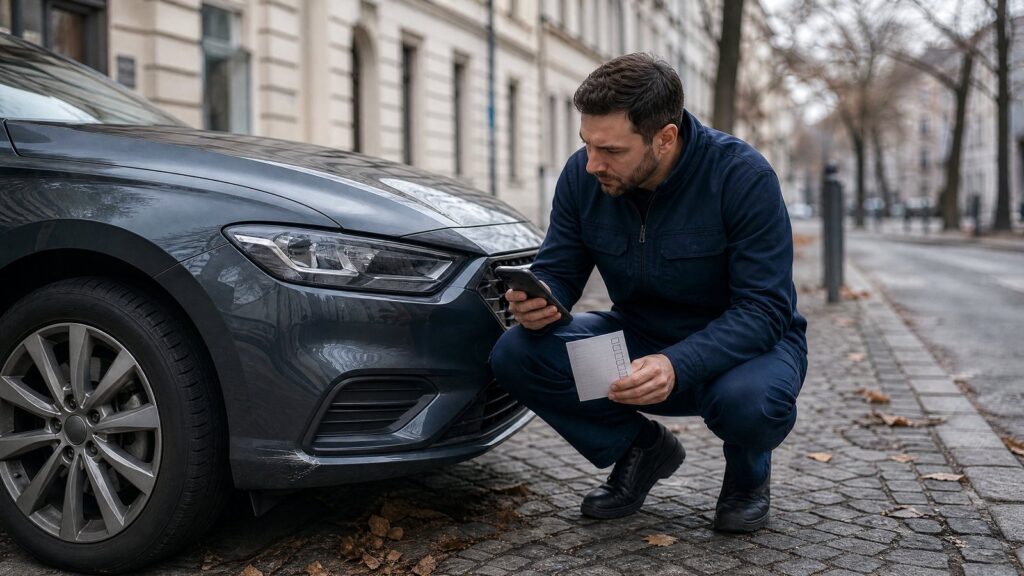
Early damage documentation is particularly valuable if the other party later tells a different version. It then matters whether the damage patterns, heights and scratch directions on both vehicles match. We measure the height of the impact points above the ground, record the direction and shape of the traces and take photos in such a way that a later comparison is possible.
For the accident report with damage documentation in Berlin, please bring photos from the accident scene, contact details of witnesses and the police reference number, if available. An accident reconstruction does not replace our documentation; it builds on it. If a reconstruction report becomes necessary, the experts commissioned can draw on our photos and measured values.
FAQ – Frequently Asked Questions
Which documents should I have ready as soon as possible?
Please have the vehicle papers, service and maintenance documents and, if applicable, photos from before the accident ready. A brief description of what happened and the contact details of other parties involved or witnesses are very helpful. This information enables a targeted and efficient initial recording so that the documented findings can be assigned more easily later. Complete documents reduce queries and support the swift preparation of the documents needed for further processing.
How important are detail photos in the appraisal?
Detail photos are crucial for the assessment because they make fracture surfaces, paint chips and transitions between damaged and intact areas visible. Such photos allow a more precise estimate of the repair effort and help to distinguish earlier previous damage from new accident consequences. In addition, well-documented detail photos are a clear basis for technical assessments and make communication with workshops and other experts easier.
Who receives the documentation and in what format?
The findings collected are prepared in a structured way and can be provided in a common, easy-to-read format. On request, they are passed on to workshops, fellow assessors or other bodies with a factual involvement. It is important that the information is transmitted completely and traceably so that all further steps are based on the same data. We discuss specific recipients with you individually to avoid unnecessary forwarding.
How do you deal with hidden damage and functional checks?
Hidden damage is first ruled out visually or narrowed down by targeted measurements. If further checks appear necessary, they are documented and the indications for in-depth examinations by specialist workshops or specialised diagnostics are marked. The aim is to name open questions transparently so that, in a next step, specialists can work out well-founded options for action. The initial recording serves as a basis, not as a final repair assessment.
Can the photos be added to later if something is missing?
Yes, supplementary documentation is possible and is often used when additional detail photos appear useful after evaluation. It is important that additions are provided with a date and context so that the chronology of the photos is preserved. Supplementary photos should relate directly to the existing documentation to ensure consistency and avoid later misunderstandings. We support you in extending the collection of material appropriately.
How are images linked to the written findings?
We link photos with clear labels, dates and reference numbers that correspond to the written findings. This allows individual photos to be clearly assigned to components, measured values or observations. This systematic link makes things easier to follow for everyone involved and reduces the coordination effort when queries arise. The aim is transparent, reproducible documentation that serves as a reliable basis in later steps.
Do you need fast, professional help?
We operate throughout Berlin and Brandenburg. Contact us for a free initial assessment.