
Motorcycle Appraisal Berlin – Accident and Valuation Reports for Two-Wheelers
A motorcycle appraisal in Berlin records damage to the frame, fork, fairing and accessories after an accident or fall and, on request, documents the value of your bike. We come to you in Berlin or Brandenburg free of charge, even if the motorcycle can no longer be ridden.
In short: An accident report for a motorcycle usually costs from 300 € to 700 €, a pure valuation from 150 € to 350 €. If the other party was at fault, their insurer also pays for damaged protective clothing such as helmet, jacket and protectors. That is why we document the motorcycle and the gear together.
Table of contents
- Steering head, fork and front frame: visual and dimensional check
- Frame and swingarm area: load-bearing capacity and dimensional accuracy
- Comprehensive recording of fairing, add-on parts and protective clothing
- Safe transport, seasonal number plates and limits of inspection for hidden defects
- Falls without another party and motorcycle electronics
- Frequently asked questions about the service
- Motorcycle appraisal in Berlin: recording damage to chassis, fairing and safety components
- Taking season, accessories and state of care into account in the valuation
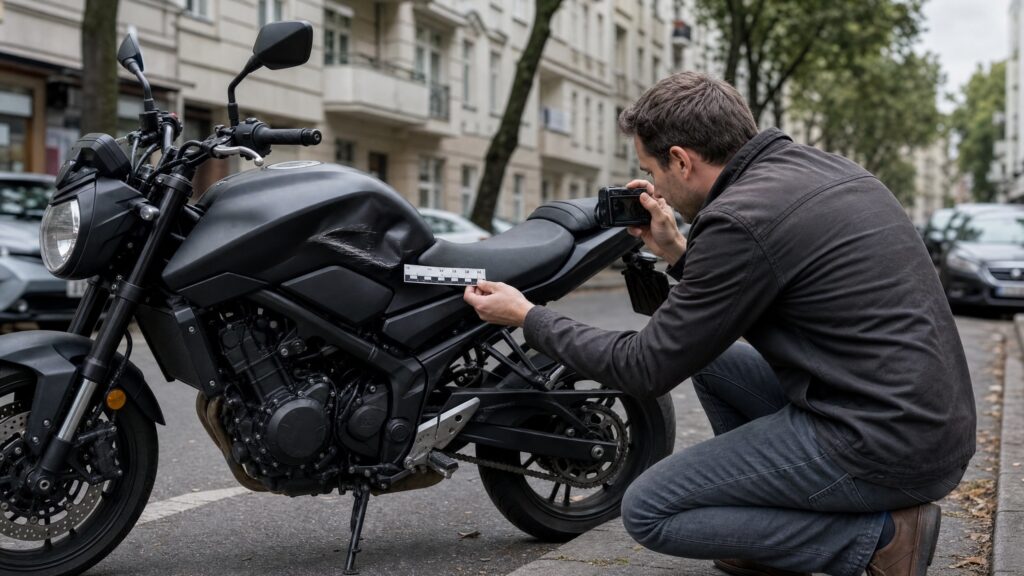
Steering head, fork and front frame: visual and dimensional check
The area around the steering head and fork is crucial for steering behaviour and riding stability. During the examination, we record play in the steering head bearings, visible deformation of the fork tubes, the condition of the fork seals and traces of corrosion or impacts. Hydraulic dampers are checked for functionality, while clamps and axle mountings are checked for true running and damage. All findings are documented in photos and in writing, so that the consequences for handling and possible consequential damage remain traceable.
You can find out more about our work as a vehicle assessor in Berlin on our home page.
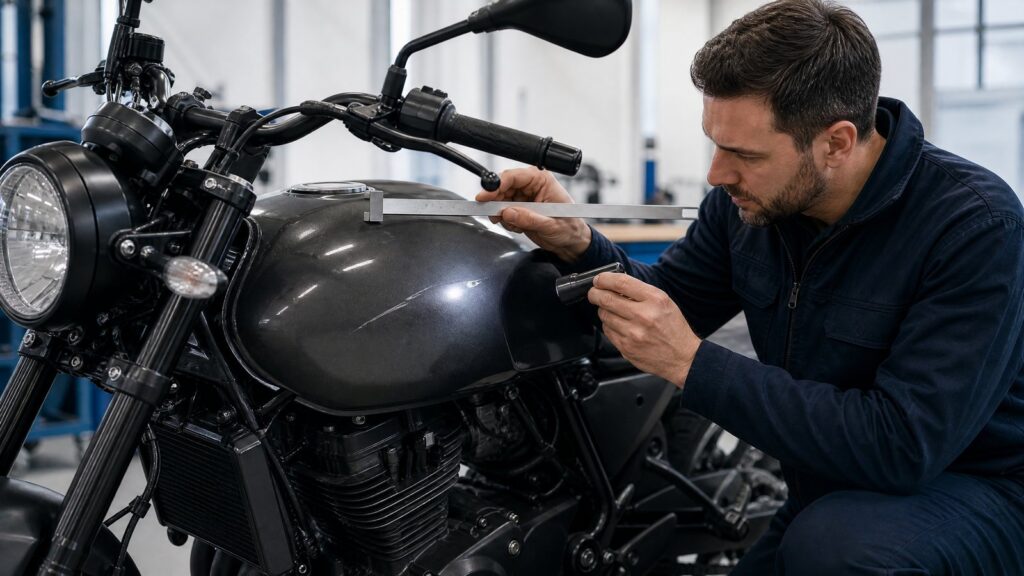
In addition, dimensional checks are carried out and compared with the manufacturer’s target dimensions, where available. Irregularities in the steering angle or offset of the axle mountings can indicate previous damage to the front end and are recorded with measuring equipment and, if necessary, test gauges. The documentation also includes the inspection steps, so that it is clear which findings are relevant for a later repair. The aim is an objective record of the condition without premature judgements.
Frame and swingarm area: load-bearing capacity and dimensional accuracy
In the central structure, we examine the frame, frame welds and swingarm for dimensional accuracy, cracks and corrosion damage. Visual inspections are supplemented by targeted measurements to identify distortion or torsion faults. Particular attention is paid to load-bearing welding seams, studs and mounting points for the engine and suspension. Precise recording of add-on or modified parts that affect the structure is important for understanding how loads are transmitted and is accompanied by technical notes.
| Inspection aspect | What we look for | Benefit of the documentation |
|---|---|---|
| Frame distortion | Track and length tolerances, visible deformation | Evidence of the effect on riding geometry and repair requirements |
| Welding seams | Hairline cracks, material abrasion, improper repairs | Identification of safety-relevant weak points |
| Swingarm bearings | Play, wear on bushes and bolts | Detection of consequential damage to suspension and drive |
If concealed areas are only accessible by dismantling, the scope of the inspection options is documented. Indications of corrosion under coatings or in cavities that can be accessed later are noted, as are the recommended further steps for a complete assessment. The combined presentation of measurements and photographic documentation allows a transparent assessment of the load-bearing capacity without premature conclusions about the repair decision.
Comprehensive recording of fairing, add-on parts and protective clothing
The outer skin and visible add-on parts provide information about the direction of impact and the forces involved. We document fracture edges, chipping, deformation and loose or missing fixings. Personal protective equipment and portable accessories are described, as they can provide clues about the accident situation. Damage to indicator, mirror or lamp brackets is also recorded, because it often allows conclusions to be drawn about load paths and is relevant to the consequences of the damage. Reliable evidence preservation on the vehicle records these traces early and traceably.
- Check the fairing mounting points for cracks and tear-outs
- Photograph fracture edges with a scale for reconstructions
- Examine add-on parts for original fitting or later modifications
- Inspect protective clothing for fracture patterns and abrasion marks
These records serve not only to determine the damage, but also to record the actual condition before any repair. Differences between surface and deeper damage are described, so that later work can be planned. The descriptions are neutral and traceable, without making judgements about diminished value or the prospects of modifications.
Safe transport, seasonal number plates and limits of inspection for hidden defects
For two-wheelers that are not roadworthy, safe transport is an important part of the inspection. Securing measures for transport, suitable lifting or lashing points and stability aspects are checked and documented. In the case of seasonal number plates or temporary deregistration, the roadworthy condition is described without drawing legal conclusions. The documentation serves to record the condition during transport traceably and to minimise possible risks.
The limits of inspection for hidden damage are communicated openly: some defects cannot be conclusively assessed without dismantling, for example in the area of internal bearings or frame cavities. Such limitations are recorded, as is a suggestion of which dismantling steps would be useful for a complete assessment. The aim is a transparent presentation of what was found and what may still need to be checked.
Motorcycle appraisal in Berlin: recording damage to chassis, fairing and safety components
On a motorcycle, even comparatively minor falls can leave marks on the handlebars, fork, wheels, braking system, fairing or footrests. The visual inspection therefore focuses not only on scratches and broken fairing parts, but also on components that can affect safety and riding behaviour.
Clear photo documentation and inspection of the affected areas help to put the repair decision on a sound technical footing. If findings are unclear, we describe transparently which further garage checks may be useful.
Taking season, accessories and state of care into account in the valuation
Motorcycle valuations often depend more on condition, season, modifications and high-quality accessories than list values alone would suggest. Well-maintained add-on parts, documented servicing or approved conversions can influence the individual classification, but must be properly described and documented.
A structured valuation makes these features visible and assigns them to the specific vehicle. This is helpful for buying, selling, insurance or an objective assessment after damage.
Falls without another party and motorcycle electronics
Not every motorcycle damage involves another party. Slipping on wet leaves, loose chippings on a bend or wildlife crossing a country road in Brandenburg often lead to a fall without anyone else involved. Whether the insurer pays then depends on your policy: damage caused by a collision with game is usually covered by partial comprehensive insurance, while a fall due to your own carelessness is covered by fully comprehensive insurance, if you have taken one out.
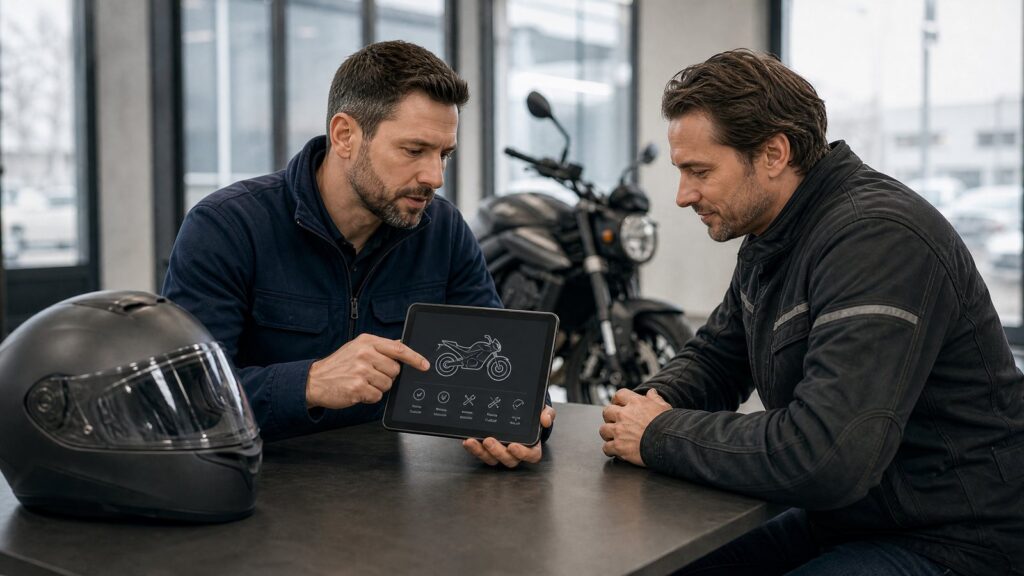
This plays a major role for a motorcycle appraisal in Berlin, because comprehensive insurers often have their own requirements for the inspection. We clarify with you beforehand what your insurer requires and document the damage so that the course of the fall remains traceable. Scrape marks on footrests, levers, mirrors and crash bars show, for example, which side the bike fell on.
On modern bikes, we also check the electronics. ABS sensors, cornering lights or traction control sometimes only report faults after a while. If necessary, we therefore read out the control units and note the entries in the report. If the bike was ridden after the fall, note whether warning lights came on or the handling changed. Slightly bent handlebars or a bent fork often only become noticeable at higher speeds. Such information helps us to measure in a targeted way instead of judging by eye alone.
For the inspection, the bike should ideally remain in the condition it was in after the fall. It is best to keep loose parts, broken levers or pieces of fairing and put them with the bike. If the motorcycle is not in Berlin but still at a workshop in the surrounding area, we will come there too. Until the matter has been clarified, you should not ride long distances on a bike whose chassis may be affected. A quick call to us will clarify whether transport makes more sense. Photos of the place where you fell, for example of chippings or an oil slick on the road, are also helpful.
FAQ – Frequently Asked Questions
Which documents should I bring to the appointment?
If possible, bring your vehicle registration certificate, service booklet, repair invoices and photos of the accident or of the condition. This information helps to attribute earlier damage, modifications or specific component comparisons. Original documents or clearly legible copies make it easier to identify parts and allow a more precise classification of the technical condition in the report. You can find additional tips on preparation in our vehicle appraisal guide (in German).
Can the report be prepared on site?
Many findings can be recorded directly where the bike is located, especially visible damage and initial measurements. If further tests are required, such as measurements on special equipment or dismantling, this is noted in the report and a follow-up procedure is recommended if necessary. The on-site recording forms the basis for complete documentation.
How do you deal with modifications or retrofitted accessories?
All modifications and accessories are recorded and described neutrally, including their design and visible methods of attachment. There is no judgement on the suitability or prospects of modifications, but possible factors influencing construction and safety are documented. Such information supports a proper assessment of the overall condition.
What does “hidden damage” mean in the report?
Hidden damage is a defect that is not visible without dismantling, for example on the inside of the frame or in lower bearings. The report states the existing limits of the examination and explains which further steps would be necessary to rule out or prove such damage. Transparency about the limits of inspection is part of objective documentation.
Who may use the report and what is it suitable for?
The report is suitable for clarifying technical conditions, supporting insurance or restoration questions and presenting damage neutrally. It contains findings, measurements and photographs that provide third parties with a traceable basis. It does not replace a legally binding decision, but serves as professional assistance.
How detailed is the description of transporting a two-wheeler that is not roadworthy?
The report describes the securing measures taken for transport and any restrictions on loading. This includes information on mounting points, lashing methods and visible damage that affects transportability. The aim is a traceable presentation of the condition before and after transport, without issuing operational instructions.
Do you need fast, professional help?
We operate across Berlin and Brandenburg. Contact us for a free initial assessment. We also offer inspections in Adlershof, Altglienicke and Biesdorf; information on costs and prices helps with initial planning.