Truck Appraisal Berlin – Assessing Damage to Commercial Vehicles
A truck appraisal in Berlin assesses damage to vans, lorries, articulated trucks and trailers so that repair, claim settlement and operations planning can continue quickly. We come to your depot in Berlin or Brandenburg free of charge and schedule the appointment around your routes.
In short: The cost of a truck appraisal depends on the vehicle and the extent of the damage: usually from 300 € to 700 €, and from 700 € to 1,200 € for major damage to the body, frame or tail lift. In addition to the repair costs, we record the expected downtime, because every day off the road costs your business money. If the other party was at fault, their insurer pays for the report.
Table of contents
- Body components, loading equipment and securing systems
- Frame, chassis and coupling connections
- Usage profile, downtime aspects and fleet documents
- Inspection location, practical checkpoints and documentation
- Damage when manoeuvring in the depot and at the loading ramp
- Frequently asked questions about the service
- Truck appraisal in Berlin: assessing damage with a view to operational readiness
- Keeping an eye on technical documentation and downtime costs
Body components, loading equipment and securing systems
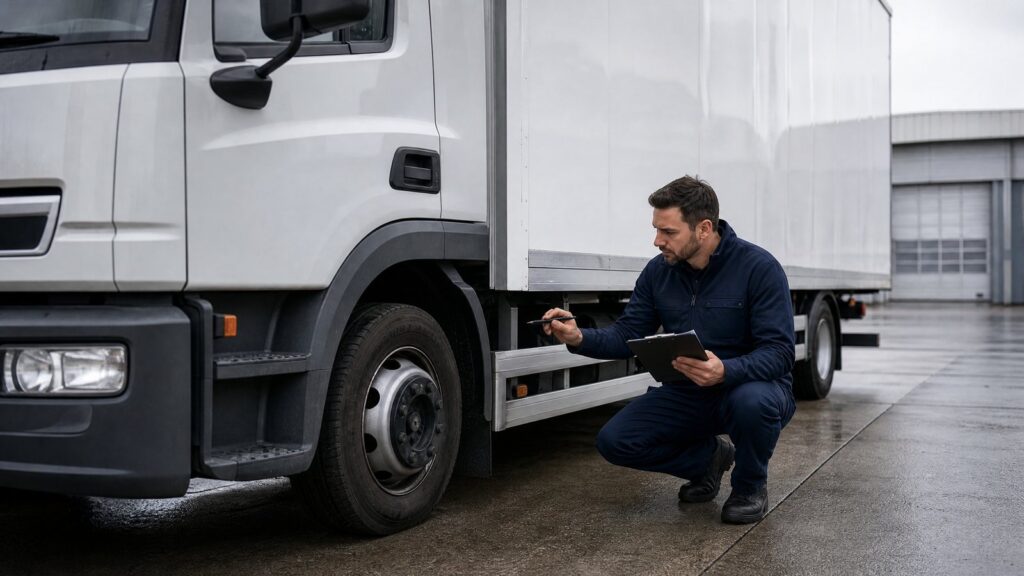
When inspecting bodies, structured visual and functional checks are the focus. As car appraisers for accident reports, we check body walls, floor panels, lashing rails and fittings for damage, the onset of corrosion and safety-relevant deformations. Particular attention is paid to the electrical and pneumatic controls of loading aids in order to detect malfunctions and to document the condition of the anchorage and fastening points. Detailed photo documentation supports the later assessment of repair requirements and suitability for further operation.
You can find out more about our work as a car appraiser for Berlin & Brandenburg on our home page.
The inspection of load securing equipment covers both the static anchorages and the movable securing elements. We assess lashing points, tie-down and direct lashing systems, lashing rails and clamping systems for their load-bearing capacity and signs of use. Roller systems, curtain and sliding elements are also checked for functionality. From the findings, statements can be derived on road safety when the vehicle is loaded, and the measures needed to restore load securing in line with regulations can be documented.
Frame, chassis and coupling connections
The chassis frame is systematically examined for cracks, distortion, corrosion and damaged areas requiring repair. Checks include a visual inspection, measurements at distinctive reference points and documentation of attachment and fastening points. Suspension, axle bearings, steering and brake units are checked for secure mounting and play in order to identify possible consequential damage. Such findings are crucial for assessing the structural integrity of the vehicle and its load-bearing capacity in future transport operations, especially when it comes to assessing total loss and residual value.
At the connection between the tractor unit and the semi-trailer, the kingpin, fifth wheel coupling, pins and mounting points must be checked carefully. The connecting elements are examined for wear, fractures or excessive play. Particular attention is paid to correct fitting and any signs of repair, as irregularities affect driving safety and load transfer. Differences between semi-trailers, tandem-axle and single-axle trailers are considered separately to avoid blanket judgements. Our service is available to you in various districts, including as a car appraiser in Tiergarten, for vehicle damage in Weißensee and as a car appraiser in Hohenschönhausen.

Usage profile, downtime aspects and fleet documents
For commercially used vehicles, including operating data, the maintenance log and the damage history is of great importance. Looking at mileage, load profiles, the frequency of special operating stresses and recurring workshop events helps to identify the causes of wear and damage-related downtime. Such information supports a technically sound classification of the findings and makes it possible to justify repair measures specifically, without making blanket statements about economic consequences. Further information on costs and prices and helpful tips can be found in our vehicle appraisal guide (German).
| Inspection aspect | What we look at | Benefit of the documentation |
|---|---|---|
| Maintenance and repair history | Existing entries, intervals, recurring defects | Enables cause analysis and prioritisation of measures |
| Operating and load profile | Average payload, types of route, frequency of heavy loads | Classification of the level of wear and forecast of technical risks |
| Downtime reports and workshop invoices | Duration and type of past damage incidents, documented repairs | Traceability of consequential damage and possible sources of defects |
These documents are evaluated in combination with the technical inspection on site in order to obtain a comprehensive picture of the vehicle’s condition. It is important to carry out separate assessments for different vehicle types, as bodies, axle configurations and usage profiles have a considerable influence on damage patterns. The combination of documentation and findings forms the basis for reliable statements on the necessary repairs and continued operability.
Inspection location, practical checkpoints and documentation
The chosen inspection location determines the scope and type of checks, whether at the depot, a workshop or a secured traffic area. For a professional on-site inspection, safe access, suitable parking areas and lighting as well as the possibility of testing the function of loading equipment are important. If necessary, parts of the body are dismantled or moving components are checked in different operating positions. The aim is practicable, reproducible documentation of findings that records both visible damage and functional defects.
- Inspection of the load floor for rust-through, twisted cross members and localised load damage
- Checking lashing points, rails and side-wall locks for strength and signs of use
- Function test of hydraulic loading aids, including leak tightness and lifting force in real operation
- Visual inspection of the coupling mounts and pins for wear and correct fastening
Photographic records, measurement records and functional notes are added systematically to provide a traceable basis for repair and valuation decisions. Precise damage documentation for claim settlement is essential here. In the case of complex damage, additional measuring methods or specialised test benches may be recommended; the choice depends on the damage situation and the operational conditions in place, so that the appraisal remains practical.
Truck appraisal in Berlin: assessing damage with a view to operational readiness
With truck damage, the assessment often concerns more than the external damage. Chassis, body, load securing, lighting, coupling systems and technical functions can influence whether and how the vehicle may be used. The appraisal records these interrelationships and separates acute safety or functional issues from purely cosmetic items.
This creates a basis on which repair, release and further scheduling can be planned sensibly. Especially with commercially used vehicles, a clear technical classification helps to avoid unnecessary downtime and unclear responsibilities.
Keeping an eye on technical documentation and downtime costs
In addition to repair items, the period of unavailability, replacement vehicles or organisational effects can be relevant for a business. The technical documentation should therefore clearly describe the extent of the damage, the expected inspection steps and the work required for a professional repair.
The more completely the initial situation is documented, the easier it is to answer queries from the workshop, fleet management or insurer. In this way, a single damage recording becomes a reliable working basis for further decisions.
Damage when manoeuvring in the depot and at the loading ramp
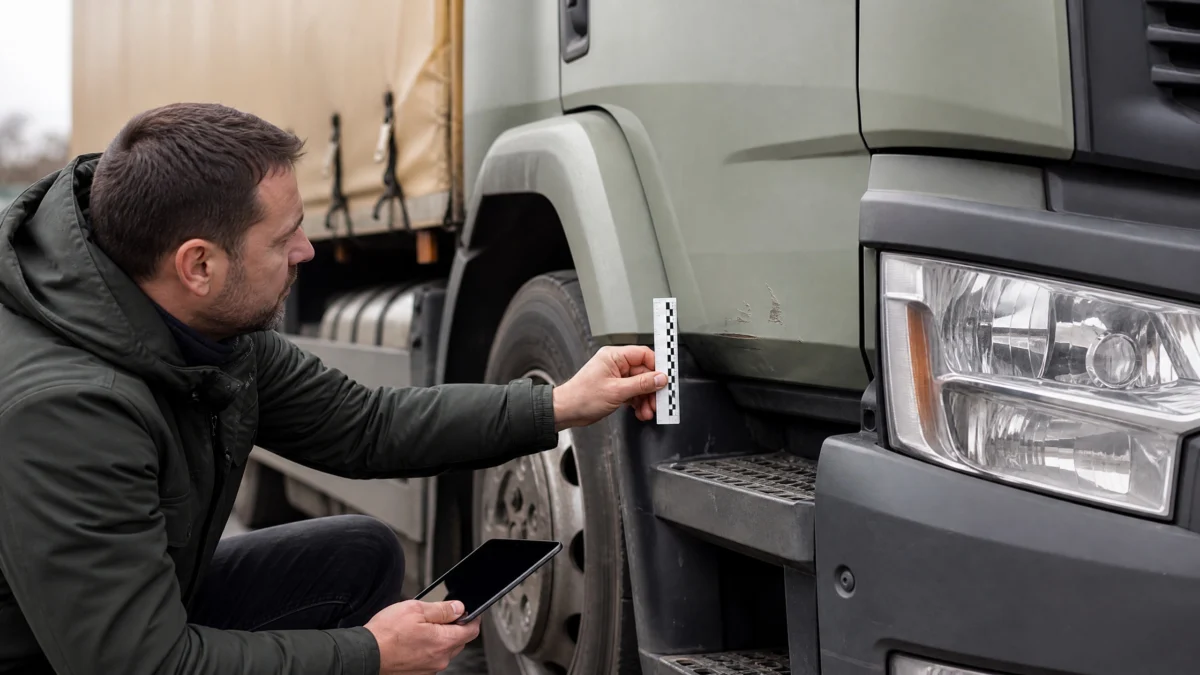
Much of the damage to lorries does not occur in moving traffic but when manoeuvring: at the loading ramp, in cramped depots or when reversing into an entrance. The rear portal, underrun protection, tail lift or side wall of the body are then often affected. Such damage appears limited at first glance but can affect brackets and hydraulics that are important for safe operation.
For a truck appraisal in Berlin, we come to wherever the vehicle is, including the depot or the workshop of your choice. We check the body, the fastening points on the frame and the function of moving parts, as far as this is possible without dismantling. Where it is necessary to look into cavities, we use an endoscope. On vehicles with assistance systems, we also read out the control units, because distance radar and cameras are located in exposed positions on commercial vehicles too.
For businesses, what counts above all is how quickly the vehicle is ready for use again. That is why we record in the report which work is urgent for road safety and which can be scheduled. This makes days of downtime and the need for a replacement vehicle traceable, and you can talk to your insurer or the other party on a clear basis. For the appointment, have the registration certificate, maintenance records and, if available, telematics data from the time of the damage ready.
We proceed in exactly the same way with trailers and swap bodies. Here, too, what counts is whether the frame, drawbar, supports and locking mechanisms still work properly. We record minor scratches on the body but clearly separate them from damage that restricts operation. The earlier we see the damage, the better it can be planned when the vehicle goes into the workshop.
FAQ – Frequently Asked Questions
Which types of commercial vehicle are covered by the examination?
The appraisal covers trucks of various classes, vans, trailers and semi-trailers as well as special bodies. Each vehicle is assessed individually according to body type and operating profile. No specific category is excluded in general, but each type requires an adapted inspection strategy, as designs and types of load differ and cannot be assessed with a uniform methodology.
Which documents should I have ready for the appraisal?
The registration certificate, body and serial numbers, maintenance records, repair receipts and, for fleet vehicles, operating records or trip logs are helpful. If available, photos from before the damage, inspection reports and operating instructions make it easier to clarify the cause. The more complete the documents, the more precisely the effects of use and possible earlier work can be included in the assessment.
Is an on-site inspection possible if the vehicle is at the business premises?
Yes, in many cases an appraisal can take place directly at the place of operation, provided the safety conditions are met and it can be carried out without danger. In some cases, it is advisable to take the vehicle to a workshop for in-depth measurements or function tests. The choice of location depends on accessibility, the inspection facilities required and the specific purpose of the appraisal.
Are loading equipment and lifting devices also inspected?
Tail lifts, cranes and other lifting devices are checked for function, leak tightness, load-bearing capacity and visible damage. Visual inspections, function tests and checking the fastenings are standard. If abnormalities are found, an in-depth examination or the use of specialised testing equipment may be recommended in order to assess operational safety unambiguously.
How can frame damage or distortion be identified?
Frame damage can be identified using a combination of methods: visible cracks and bulges, comparison of measuring points to detect distortion and, if necessary, additional measurements. Corrosion spots and welding work carried out are also documented, as they provide indications of earlier repairs or load events. The results provide a basis for technical assessments.
Who can use the documentation of the appraisal?
The documentation produced contains technical findings, photos and measured values that support workshops in planning repairs and can serve as a basis for internal decisions. Whether and how third parties use these documents should be clarified with the respective recipient. The evaluation aims at technical clarity and traceability, without making legal or economic determinations.
Do you need fast, professional help?
We operate throughout Berlin and Brandenburg. Contact us for a free initial assessment.