
Motor Vehicle Appraiser Berlin Dahlem: Thorough Inventory and Assessment Clarification
Differentiated Appraisal with a Focus on Traceable Baseline Data
For complex technical issues, accurately recording the vehicle's condition is crucial. In Dahlem, it is frequently essential to clearly document the differences between age-related wear and tear and damage-related alterations. A thorough inventory encompasses visible damage, hidden deformations, repainting, measurement values such as paint depth, and seamless photographic documentation from defined angles. Vehicle documents, maintenance records, and prior appraisal reports are equally important, as they provide reference benchmarks. In practice, we also consider details regarding the vehicle's history and test technical components for operational functionality. The objective is to establish an objective, verifiable basis that you can utilize for internal decisions, discussions with repair shops, or communication with third parties. We do not provide legal conclusions; we deliver verifiable inventory documentation and possible technical classifications.
District

Why a Precise Condition Assessment Makes Sense
If a vehicle's baseline condition is not unequivocally recorded, ambiguities frequently arise regarding liability issues, repair scope, or valuations. Particularly in Dahlem, where vehicles of varying ages and service histories are encountered, detailed documentation creates a reliable foundation. This includes comprehensive photos from all sides, close-ups of damage, documentation of the VIN and mileage, as well as the review of available invoices, general inspection (HU) reports, and service booklets. For buyers and sellers, a structured inventory provides clear orientation regarding genuine wear and tear; for repair shops, a basis for preparing quotes; and for experts, a baseline for technical evaluation. Please ensure you present original documents or legible copies and point out abnormalities such as unusual noises, odors, or functional limitations. We describe, measure, and photograph objectively; technical assessments can be derived from this data, but not legal advice.
Precise Core Tasks of the Appraisal
The assessment is structured into several coordinated tasks that collectively form the complete picture.
Damage Assessment with Measurement Protocol
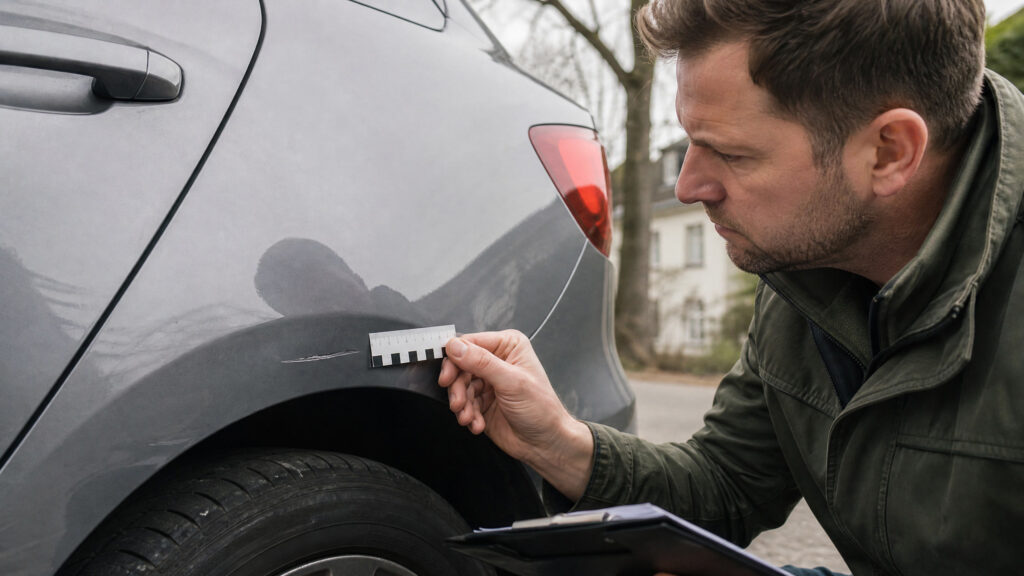
During the damage assessment, visible deformations, cracks, paint damage, and panel gaps are systematically recorded. In addition, we conduct paint depth measurements to identify previous repainting and document clearances between body parts to detect structural deformations. Every affected component receives clearly labeled photographic evidence with a scale and viewing direction. This allows secondary damage and the required scope of repair to be reliably assessed. This is particularly relevant should subsequent disputes arise regarding repair billing or the assessment of pre-existing damage. Records are organized chronologically to ensure all observations remain completely traceable.
Valuation and Residual Value Analysis with Document Reconciliation
To determine value, market values are compared, and deductions for age-related wear and tear are separated from accident-related loss of value. Maintenance records, repair invoices, service history, and existing appraisal reports are incorporated into the valuation. For vehicles with special equipment or historical features, we examine whether modifications affect the valuation. A traceable residual value determination takes into account current technical functionality, visible damage, and documented previous conditions to provide a realistic baseline for sale, purchase, or settlement with third parties.
Preparation for Purchase, Sale, and Lease Return
Prior to a purchase or lease return, an inventory assessment is recommended to reveal potential points of contention: hidden damage, poorly executed repairs, or discrepancies between reported condition and actual findings. We verify entries in the vehicle registration certificate, cross-reference standard and modified equipment features, and check for missing or non-original components. Documented defects are accompanied by photographic evidence and prepared in a report that enables buyers and sellers alike to make well-informed decisions.
Basic Technical Tests and Electronic Diagnostic Readout
Alongside visual inspection, operational tests of the brakes, steering, lighting, and safety systems form part of the baseline check. If required, a standardized readout of diagnostic fault memories is carried out, which can provide indications of hidden malfunctions or manipulated components. Findings from electronic diagnostics are cross-referenced with mechanical assessments to better evaluate technical correlations. The result is a combination of visual findings, functional status, and electronic diagnostics serving as the basis for further measures.
Key Elements of a Robust Vehicle Inventory
A robust inventory assessment rests on three pillars: clear photographic documentation, verifiable measurement values, and complete records. In Dahlem, it is advisable not only to photograph obvious damage, but to systematically capture reference shots of the vehicle surroundings, detailed images of critical components, and measurements with a scale. Documentation such as the service booklet, repair invoices, inspection reports, and any prior appraisals is also vital, as it allows comparisons and substantiates changes over time. Technical measurement values, such as paint thickness and panel gaps, allow natural aging processes to be distinguished from damage-related interventions. Ultimately, a structured protocol creates clarity for all parties involved because findings, measurement methodology, and the scope of validity are transparently documented.

Clarity for Negotiations
A precisely documented baseline creates an objective foundation for price negotiations or coordination with insurance companies.
Reliable Evidence for Repair Shops
Through a detailed inventory, repair shops receive a concrete basis upon which they can develop sensible repair concepts and cost estimates.
Planning Certainty for Purchase and Sale
For buyers and sellers, structured documentation serves as a guide: It highlights technical deficiencies, documented maintenance, and potential depreciation, thereby supporting a...
Diligence, Not Speculation
The documentation aims to compile verifiable facts rather than assumptions.
Situations Where a Detailed Assessment Is Recommended
A structured inventory is advisable following an accident, when intending to buy, prior to lease returns, or when uncertainties exist regarding past repairs. In Dahlem, this can be particularly relevant for premium vehicles with incomplete histories or older vehicles with potential corrosion concerns. A professional assessment is also recommended in the event of visible discrepancies between user statements and actual findings, such as manipulated mileage or unclear repairs. The earlier the documentation is carried out, the better changes can be preserved; in the case of severe damage, it is advisable not to move the vehicle until an initial appraisal has taken place. The assessment provides a foundation for technical decisions and facilitates subsequent settlement or valuation.
Measurability Over Impressions
Measurement values and photographs replace subjective impressions with verifiable data. This increases traceability for third parties and lends credibility to the findings.
Documented History
A complete protocol establishes a chronological sequence of findings, helping to separate cause and effect and to track subsequent changes.
Sound Reasons for Systematic Recording: Why Structured Findings Make the Difference
A Basis for Decision-Making Instead of Speculation
With clear findings, options can be evaluated more effectively: repair, sale, decommissioning, or further inspections are planned on the basis of verifiable facts.
Detectability of Hidden Damage
Through targeted technical checks and electronic data readouts, defects that would be missed by purely visual inspection can be discovered. This minimizes future surprises.
Steps of On-Site Damage and Condition Assessment
The process is carried out in sequential steps that are methodically documented to ensure every observation remains fully traceable.
Preparation and Document Review
Before inspecting the vehicle, existing papers are reviewed: registration documents, service booklet, invoices, and previous appraisals. Note down known previous incidents and present the current mileage as well as the keys. This advance information enables a targeted inspection and minimizes unexpected issues during the assessment.
Exterior Check and Dimensional Measurements
Exterior shots follow a defined protocol: full views from four perspectives, close-ups of edges, panel gaps, and damage, as well as paint thickness measurements at significant points. Every photograph is documented with its viewing angle and, where appropriate, a scale, enabling reliable future comparisons.
Interior, Technology, and Diagnostics
In the interior, upholstery condition, safety equipment, and visible damage are logged. Technical inspections include checking the brakes, steering, and lighting, as well as reading diagnostic trouble codes where necessary. Functional limitations are described and, whenever possible, reproducible tests are recorded.
Final Documentation and Review of Findings
To conclude, all findings are consolidated, the photo archive is structured, and a report is compiled with clear descriptions and explanatory notes on the scope of the assessment. The results are explained, open points are identified, and, if necessary, recommendations for further diagnostic investigations are made.
Answers to Specific Documentation Questions
Here you will find precise explanations regarding the selection of documents, photographs, and technical questions that regularly arise during an inventory assessment.
If possible, please bring the vehicle registration certificate, service booklet, invoices for relevant repairs, periodic inspection (HU) reports, and previous appraisal reports. These documents allow for chronological comparisons and help identify recurring issues or missed maintenance. If all keys or special operating manuals are available, they should also be kept at hand, as they provide insight into standard equipment and modifications. Copies are sufficient, provided all details are legible.
Photographs should be systematic: overall shots from all sides, details of damage from various angles, and close-ups with a scale or recognizable reference point. Ensure consistent lighting and avoid reflections so that contours and color shades are accurately reproduced. Additional shots of the vehicle identification number (VIN), mileage, and interior defects enhance the traceability of the findings.
Pre-existing damage often becomes apparent through uneven paint thickness, misaligned panel gaps, or discrepancies in the positioning of components. Invoices or workshop stamps in the vehicle history also provide important clues. A comparison with documented reference photos or measurement values from previous appraisals can provide clarity; ultimately, the combination of documentary evidence and metrological inspection is decisive.
Incompletely executed repairs or provisional fastenings are risk factors for consequential damage. Loose connecting elements, missing fasteners, or improperly performed weld seams can compromise road safety. Such conditions are highlighted in the report and documented with photos so that priorities for repairs can be set.
For the valuation, functional limitations, visible damage, and documented maintenance condition are brought together. Defects in safety-relevant components lead to higher deductions, whereas proven regular servicing supports the market price. Special features such as retrofitted equipment or rare components are appraised separately, as they can influence market value.
Through targeted functional tests and visual inspections, immediate hazards can be identified: e.g., leaks in brake lines, significantly restricted steering play, or defective lighting. Such defects are described in terms of their potential impact on road safety and, if necessary, highlighted as risks requiring immediate remediation, allowing you to establish sensible repair priorities.
The findings are compiled in a structured report containing all photos, measurement values, and relevant document references. The report clearly states the inspected points, the results, and any limitations to the validity of the assessment. You will receive the documentation in a format ready for further technical or commercial steps; supplementary questions will also be clarified, provided they do not fall within the scope of legal advice.
Note down any anomalies, bring relevant documents, and, if possible, provide access to all vehicle keys. Ensure that the vehicle is parked in an area that allows for full 360-degree photography, and inform us of any known prior incidents. This preparation saves time and enhances documentation quality, as reference points and context are available early on.
Typical measurements include paint depth at multiple points, panel gap dimensions on body parts, as well as baseline measurements of tire pressure and brake pad thickness. If required, a diagnostic scan of the electronic control units is also performed. This combination of mechanical and electronic data collection allows for a more comprehensive technical classification of the findings.
Non-visible defects, such as electronic malfunctions, are documented through tests and diagnostic readouts. The report details the method by which the fault was verified, what consequences are plausible, and what further examinations are recommended. This creates an objective basis for decisions regarding transport, repair prioritization, or further professional inspections.
Next Steps for a Thorough Assessment
If you require a reliable baseline condition of your vehicle in Dahlem, systematic preparation helps: collect documents, note observations, and ensure unobstructed photography conditions. A structured assessment saves time in subsequent discussions with workshops or third parties and reduces the risk of disputed supplementary claims. Share relevant paperwork in advance so the assessment can proceed efficiently. Our focus is on transparent results and practical guidance so you can make well-founded decisions. In doing so, we always maintain transparent costs and are also at your service in neighboring districts such as Zehlendorf and Schmargendorf.