
Accident Report Berlin – Independent Car Appraiser After an Accident
This page is about the classic accident report after a road traffic accident caused by someone else: we determine repair costs, loss in value and downtime, and the costs are usually borne by the other party’s insurer. If you mainly need complete documentation from the scene of the accident, for example because the sequence of events is disputed, see accident report & damage documentation. For comprehensive (Kasko) insurance claims or parking damage, the damage report is the right route.
Table of contents
- Securing the accident scene and first steps
- Photographic and written documentation immediately after the incident
- Identifying visible and hidden areas of damage
- Repair method, economic considerations and communication with insurers
- Which items are included in the accident report
- Frequently asked questions about the service
- From recording the damage to a usable report
- Which details make claim settlement and repair planning easier

Securing the accident scene and first steps
After a road traffic accident, averting danger and securing the accident scene take priority. As far as possible and as your health allows, you should switch on the hazard warning lights, set up a warning triangle at a sufficient distance and move yourself and others involved to a safe place. If anyone is injured, the emergency services must be called immediately. As appraisers, we recommend not getting into conflicts with other road users and clarifying open questions later as part of the damage recording, so that safety remains the priority.
You can find out more about our work as a motor vehicle assessor in Berlin on our home page. How to protect your rights after an accident caused by someone else is explained on our page on the third-party liability damage report.
Immediately after the incident, a systematic approach makes sense: note the time, weather and visibility conditions and the positions of the vehicles. Collect contact details of those involved and witnesses and look out for any dashcam footage. These early measures support a traceable account of the accident and make the substantive appraisal easier later. If required, we also document the situation on site with scale sketches and photos. This is particularly important for evidence preservation.
- Photograph visible vehicle positions and directions of travel
- Document traces such as skid marks, debris and fluid leaks
- Note the contact details of everyone involved and witnesses, as well as registration numbers
- Check safety equipment and that the accident scene is secured
Photographic and written documentation immediately after the incident
Comprehensive photo and note documentation forms the basis for reliable damage recording. Photograph the vehicles from several angles, take close-ups of damaged areas, the height and extent of the damage and, where relevant, the vehicle interiors. Written notes on observations, noises and the course of the accident are also important. These records should be dated and bear your name so that it is clear later when which information was collected.
| Inspection aspect | What we look at | Benefit of the documentation |
|---|---|---|
| Exterior photos | Extent of damage, paint abrasion, deformations | Evidence of the consequences of the accident and the extent of damage |
| Traces at the scene | Skid marks, distribution of debris, slide marks | Supports reconstruction of the sequence of events |
| Vehicle data | Chassis number, registration number, model variant | Allows correct identification and assessment |
The combination of images, measurement data and written information makes a verifiable assessment easier. When the report is prepared later, this information is put in chronological order and linked to technical findings. This allows visible damage, the immediate effect of the accident and indications of possible hidden damage to be placed in a comprehensible context. Solid documentation reduces uncertainty and forms the basis for a proper assessment.

Identifying visible and hidden areas of damage
During the appraisal, we distinguish between immediately visible damage and damage that only comes to light on closer inspection. Visible damage affects bodywork, lighting and glazing; hidden damage is often found in the suspension, steering, frame or electrics. An external assessment alone is often not sufficient. Structured measurements, functional tests and, where necessary, dismantling of individual areas are therefore part of a thorough analysis to avoid later defects.
For a technically sound assessment, documenting the findings in combination with the repair history and service records is important. This helps to distinguish between pre-existing and accident-related damage. As appraisers, we explain the damage patterns found clearly and comprehensibly so that the decision for certain repair measures or further checks can be presented on a sound technical basis.
Repair method, economic considerations and communication with insurers
Weighing up repair to original condition, alternative repair methods and economic aspects is a central part of the report. A technical finding describes the necessary measures and names suitable workshop procedures without replacing binding repair instructions. Transparency is decisive: which work is necessary, which is purely cosmetic and what consequences can arise if it is not carried out. This creates a basis for your objective decision-making, including on questions of total loss and residual value.
If the insurer settling the claim has queries, we help to explain the technical content of the report clearly and comprehensibly. This includes setting out inspection steps, naming measured values and showing which findings make a particular measure necessary. We answer technical queries objectively, refer to the documented findings and word the answers so that the insurance processes are supported by technical objectivity.
From recording the damage to a usable report
After the initial contact, the appraisal is prepared so that the vehicle, the damage pattern and the available documents match. During the inspection, the affected areas are photographed, conspicuous components are checked and relevant details of how the accident happened are recorded. Depending on the damage situation, this also includes indications of hidden damage, functional tests or further workshop diagnostics. We are there for you as a car appraiser in Berlin Mitte, Charlottenburg and Spandau.
The result is structured in an understandable way: which damage is recognisable, which repair measures are technically appropriate and which documents should be available for the claim settlement? This gives you a technical basis that allows the workshop, insurer and other parties to refer to the same state of affairs more quickly. Information on costs and further tips can be found in our guide (German).
Which details make claim settlement and repair planning easier
Photos from the accident scene, contact details of those involved, the registration certificate and – where available – information from the police or insurer are helpful. Earlier damage, repairs and workshop appointments already agreed should also be disclosed openly. This makes it easier to distinguish current damage from pre-existing traces.
An orderly set of documents does not replace a technical inspection, but it reduces queries. It creates a traceable link between the actual condition of the vehicle, the documented damage and the next steps up to repair or settlement.
Which items are included in the accident report
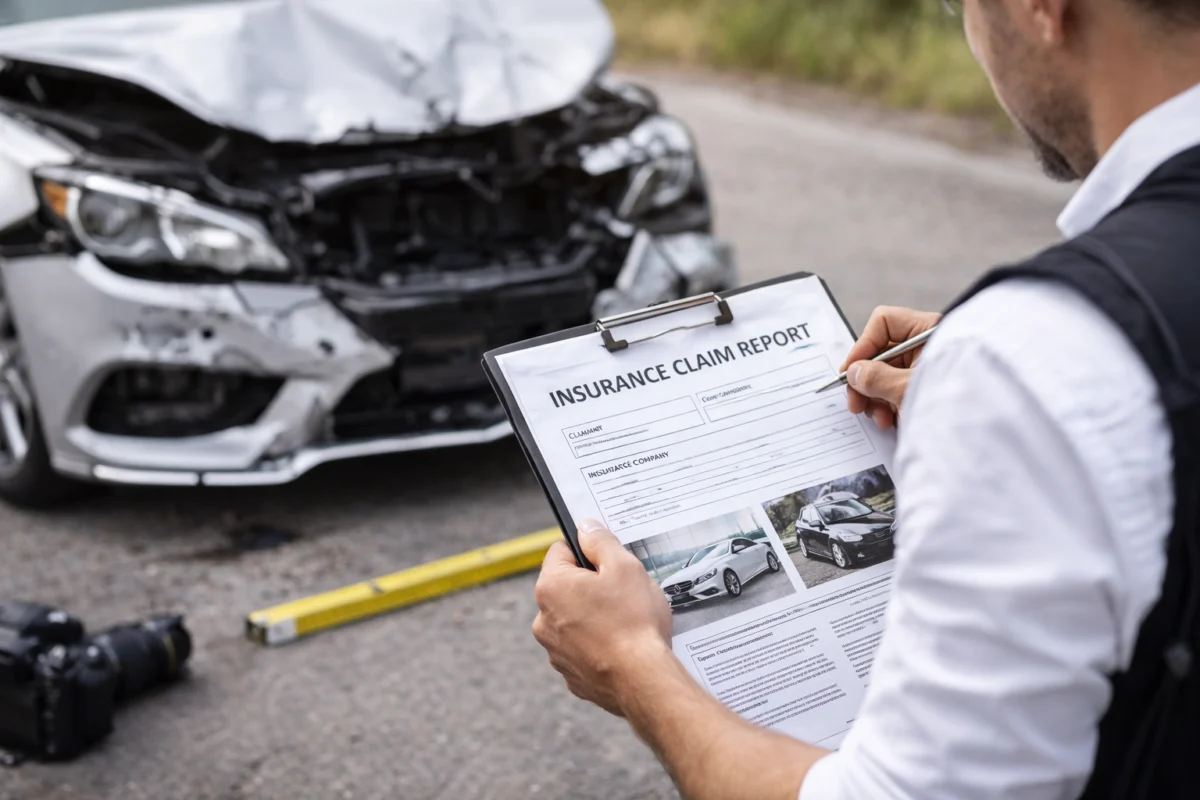
An accident report is more than a total at the bottom of the page. So that you can prove all your claims against the other party’s insurer, we list the individual items separately. These include the repair costs with spare parts, labour and paintwork, the expected repair time and, if the damage makes the vehicle worth less on the market, the reduction in market value (merkantile Wertminderung).
If the repair costs are close to the value of the vehicle, we also determine the replacement value and the residual value. Only with these two figures is it possible to say whether a repair is still worthwhile or whether the vehicle is an economic total loss. For the time without a car, it is also important which vehicle group your car falls into. This determines which hire car is appropriate or how high compensation for loss of use can be.
With modern vehicles there is another point: after front or rear damage, cameras and radar sensors of the assistance systems often have to be recalibrated. If necessary, we read out the control units and include the calibration in the costing so that these costs do not have to be discussed later as a supplement. The result is an accident report for Berlin and Brandenburg that the workshop, lawyer and insurer can all work with.
FAQ – Frequently Asked Questions
When should I request a report?
You should think about an independent damage assessment as early as possible after the accident, especially if the question of fault is unclear, if there is visible damage beyond pure panel damage or if hidden damage is suspected. Early documentation secures evidence and supports your later decision-making. A report helps to present the technical extent of damage objectively.
Which documents are helpful for the appraisal?
Relevant documents are the registration certificate, service and repair records, accident reports, photos from the accident scene and police reports, if available. The vehicle’s previous history can also help to identify pre-existing damage. The more complete the documents, the better the findings can be classified properly.
Who decides on the repair method?
The decision is basically yours as the vehicle owner. An expert report offers a professional recommendation on the necessary measures and possible alternatives. Workshops can suggest technical options; the report provides the neutral basis so that you can weigh up different quotes and repair concepts.
How is hidden damage detected?
Hidden damage is detected through targeted functional tests, visual checks after partial dismantling and measuring methods. Test drives and electronic diagnostics can also provide indications. Transparent documentation of the test equipment and results is important so that later complaints can be assessed comprehensibly.
What happens if the insurer settling the claim has queries?
In the case of technical queries, we provide objective explanations based on the documented findings. This can include presenting measured values, photos or repair requirements. The aim is to present technical facts in an understandable way so that the insurance processing can take place on a solid technical basis.
Can reports also make sense for minor damage?
Even with seemingly minor damage, a report can make sense if there is uncertainty about consequential damage or the cause of the accident. An objective record is suitable for avoiding later surprises and creating a basis for proper repair decisions. We are happy to clarify whether a report is needed after reviewing the documents.
Do you need fast, professional help?
We operate throughout Berlin and Brandenburg. Contact us for a free initial assessment.