
Car Appraiser Berlin Tiergarten: Focused Damage Assessment
Clear technical findings. Objective decisions.
With complex damage, technical clarity determines safe and economical next steps. In Tiergarten we focus the inspection on the points that directly decide on continued operation, the scope of repairs or a replacement decision: load-bearing components, chassis and steering, airbag and restraint systems, electrical components and visible as well as hidden body damage. You find out exactly which measured values, visual findings and photographic evidence are relevant. Bring the registration certificate, current photos, known repair invoices and, if available, the accident report. We strictly distinguish between previous damage, fresh damage and repaired areas, and show which areas still need to be checked by measurement. The aim is a tightly focused report that answers technical questions and creates the basis for further decisions – without digressions into flat-rate valuations or legal advice. We also offer our focused damage analysis in neighbouring districts such as Mitte and Moabit. As a car appraiser for Berlin & Brandenburg, we also come to you in Tiergarten free of charge.
Service area
From findings to decision: precise steps
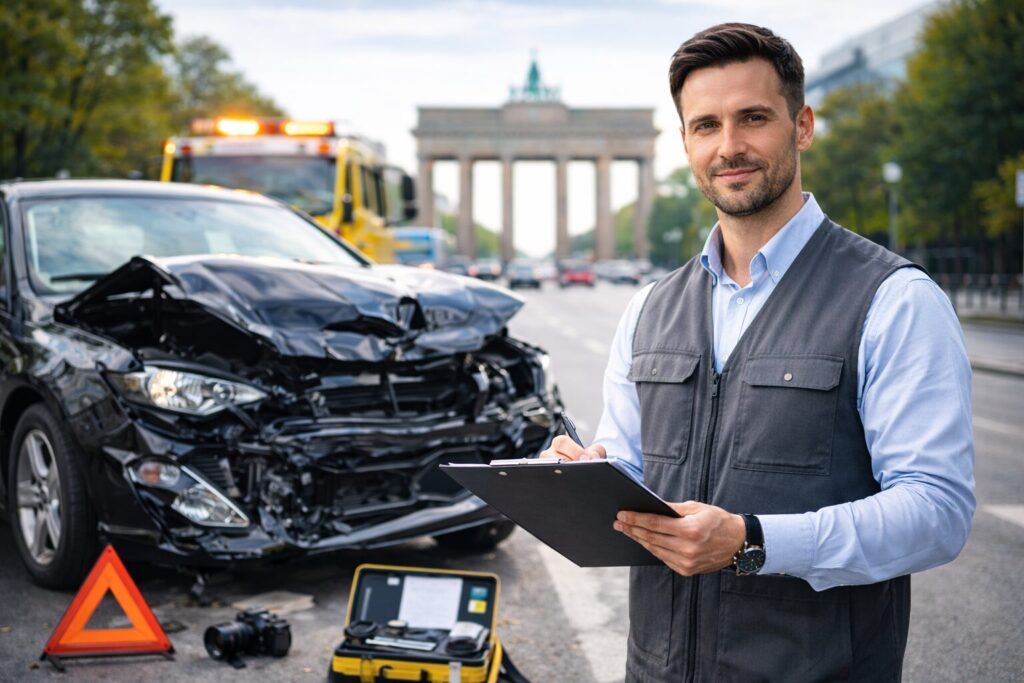
A robust appraisal follows a clear sequence: first we check the available documents for identity and history, then the vehicle is systematically inspected and measured. In Tiergarten this starts with matching the VIN, registration certificate and order data, followed by a documented photo series of the damaged areas from defined perspectives. Visible deformations in load-bearing areas, deviations in the wheelbase, differences in panel gaps and cracks in weld seams take priority. At the same time, we check the repair status, material transitions and mounting points in order to distinguish fresh from older repairs. Electronic fault memories, airbag status and sensor functions are read out as far as possible and correlated with the visible findings. We document measurement results with the date, type of measuring device and tolerances. The end result is a targeted findings report that prioritises technical risks, gives concrete advice on how to proceed and provides an evidence-based assessment of the scope of restoration or of restrictions on use. This structured approach helps to justify decisions to garages and insurers and reduces later doubts. Find out more about our costs & prices.
Focus on the technically relevant services
Our services concentrate on what is technically decisive: clear findings, precise photo and measurement documentation, and a meaningful final assessment. Below are our service areas, each with a description.
Technical survey and measuring technology
We record deformations, panel gaps and parallelism deviations using defined measuring methods. These include length and angle measurements on the chassis, visual inspection of load-bearing body elements and, if necessary, measurement of the wheelbase and axle geometry. Measurement results are compared with tolerance-based references, documented and backed up with photos. If required, we also record material transitions and images of weld seams in order to distinguish fresh from older repairs. The aim is to identify technical causes and to provide the data needed for decisions on repair or taking the vehicle off the road. This is an important part of our damage reports.
Photos, document check, damage chronology
Robust photo documentation follows standardised perspectives: close-ups of the damaged area, overview shots of the sides, front and rear of the vehicle, and detailed shots of components and fastenings. At the same time, we check the registration certificate, key numbers, existing invoices and accident reports in order to set out the chronological sequence of previous damage, repairs and the current incident. This chronology is important for drawing distinctions and proving which defects are attributable to the current damage and which already existed. We also offer evidence preservation.
Safety-related assessment and recommendation
We assess whether a vehicle can be used safely from a technical point of view or whether measures are required to restore roadworthiness. This includes checking steering components, suspension, brakes, airbag status and structural integrity. If the repair effort is unclear, we give prioritised options for action: measurement data for repair approval, safety-relevant elements to be secured immediately, or recommendations for a further specialist inspection. The report remains objective, shows risks and makes a balanced decision easier. Find out more about our vehicle valuation.
Result document and traceability
Every appraisal contains a structured results page with findings, measured values and photographic evidence in chronological order. It is important that the report makes decisions traceable: which components were affected, which measured values justify the assessment, and which further checks make sense. This gives you a basis for decisions tied to technical aspects, without legal interpretation.
Why technical precision supports the decision
Small deviations in panel gaps or an undetected deformation of load-bearing parts often have a major impact on repair effort and safety. Again and again there are cases in which superficial repairs do not eliminate hidden damage; only systematic measuring technology and documented photo series make such risks visible. Precise findings prevent wrong decisions such as unnecessary replacement work, premature release for use or missed safety measures. In addition, clear documentation reduces later disputes about interpretation: if measurement results, measuring methods and image perspectives are traceable, the cause and extent of damage can be separated in a technically correct way. This creates the basis for economically sensible and safety-oriented decisions.

Clarity instead of assumptions
You receive findings that name technical causes rather than merely describing visual damage patterns.
Prioritisation by risk
The report ranks findings according to their safety relevance.
Tiergarten: checking the consequences of damage thoroughly
A structured results page with data, images and measurement records makes communication with garages and insurers easier and reduces queries thanks to clear technical evidence.
Saving time in decisions
Focused inspections save time: we concentrate on the relevant technical points and avoid sprawling, unproductive examinations.
Situations in which a focused inspection makes sense
Request a focused technical inspection if there is uncertainty about the scope of repairs or roadworthiness. In Tiergarten, such situations arise, for example, after parking collisions, rear-end collisions, manoeuvring bumps or when garages give differing assessments of the condition. Technical clarification is also important if hidden structural deformation is suspected, after an airbag has deployed or if there is previous damage. Prepare photos of the damaged area, the registration certificate, existing repair receipts and, if available, an accident report. If repairs have already been carried out, bring invoices and parts lists. The aim of the inspection is to make technical risks visible, not primarily to estimate costs; this can follow once the technical basis is clearly established.
Separating technology from speculation
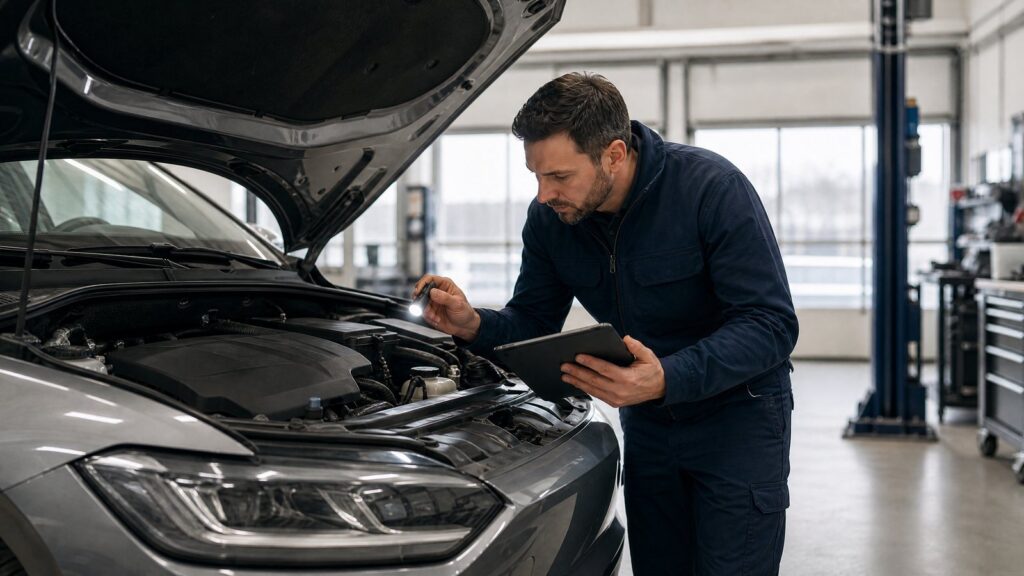
We separate facts from assumptions: visual findings and measurement results form the basis, and hypotheses are clearly identified as such. This gives you an objective basis for further steps.
Use of suitable measuring methods
Not every inspection requires elaborate measuring technology, but where it is relevant we use suitable equipment and document the measuring device and tolerances. This increases the significance of the results.
Decisions based on technology: why our focused approach works
Action-oriented report
Every appraisal concludes with concrete recommendations: immediate measures, priority checks and options for restoring roadworthiness. This makes it easy to plan the order of the measures.
Reducing avoidable points of dispute
Clear photo documentation and traceable measurement records reduce the risk of later disputes about interpretation between garage, owner and insurer.
Structure of the inspection – objective and focused
The inspection follows a fixed procedure in order to clarify all relevant technical questions systematically.
Initial contact and preliminary check of documents
We review your registration certificate, existing invoices and photos in advance in order to plan the scope of the survey. Clear information about the history allows targeted measurements and avoids unnecessary work steps.
Orderly visual documentation
On site, we take a standardised photo series: overviews, close-ups and detailed photographs with scales. Visual inspections concentrate on deformation zones, mounting points and material transitions.
Targeted measurements and electronic testing
Where deviations are visible, we carry out length, angle and panel gap measurements and read out the available fault memories. Measuring devices and measuring conditions are stated in the report.
Evaluation, prioritisation, discussion of results
The findings are ranked by risk and urgency. You receive an understandable explanation of the technical conclusions as well as a printed or digital overview of results with photographic evidence and a measurement record.
FAQ – Frequently Asked Questions
Answers to typical questions that help you prepare the inspection in a technically sensible way and put the results into context.
Which documents should I bring to the inspection appointment?
Bring the vehicle registration certificate (Zulassungsbescheinigung Teil I), all invoices for recent repairs, service books, any accident reports and photos of the damage from different perspectives. In addition, information on previous damage, replaced parts or existing appraisals is helpful. These documents allow a quick check of identity, technical specifications and history and reduce the time needed for preliminary research, so that the examination can concentrate directly on technically relevant checks.
How do I take the best photos for the damage assessment?
Photograph the damaged area from several angles: an overall view from the side of the vehicle, close-ups with a scale (e.g. a ruler) and detailed shots of mounting points, weld seams or crack edges. Make sure there is enough light, avoid strong backlighting and take additional pictures of the underbody and wheel arches if there are visible changes there. Such photos support the classification by measurement and make it easier to distinguish fresh from older damage.
How is the vehicle history taken into account in a damage assessment in Tiergarten?
Previous damage is documented and placed in the vehicle’s chronology. We compare material transitions, paint differences and existing repair seams to determine which defects are attributable to the current incident. Invoices and earlier appraisals are valuable here. The aim is to provide technical evidence for a clear chronological distinction, not a legal assessment of responsibility.
Why is the garage status relevant for a damage assessment in Tiergarten?
The current repair status influences which examinations still make sense. If parts have already been removed or provisionally repaired, we concentrate on the remaining structural evidence and specifically ask for invoices and spare part numbers. If repairs conceal complete replacement areas, this can impair measurability; in such cases we document the condition before and after the repair as well as the available evidence.
How is the technical scope of restoration determined?
The technical scope of restoration results from the combination of visual findings, measurement results and the inspection of safety-relevant systems. We identify which components must be repaired or replaced, which adjustments are required and where measurement data show critical deviations. The appraisal report names these points and provides a prioritised list of technical measures that can serve as the basis for cost estimates or repair approvals.
Can the inspection provide information about driveability and usability?
Yes. Part of our assessment includes an evaluation of whether the vehicle is currently roadworthy or whether immediate measures are required. This concerns steering and suspension parts, brake functions, airbags and structural integrity. We give technical advice on safe use or on the necessary decommissioning until repair, always on the basis of the findings and measured values.
How can I prepare for the appointment if the vehicle is not driveable?
If possible, provide detailed photos of the vehicle, note the existing damage and collect any available receipts. Let us know about any access restrictions so that we can estimate the scope of the examination in advance. If the vehicle cannot be moved, we plan the inspection so that critical access points are taken into account and the necessary testing equipment is brought along.
Clear technical findings for your decision
When the technical situation is unclear, focused findings are often more useful than a long appraisal without focus. In Tiergarten we offer a targeted examination aimed at the points relevant to safety and decision-making: measurement data, photo documentation and a prioritised presentation of results. Prepare your registration certificate, existing invoices and photos; we deliver a traceable report that clearly describes the technical situation and serves as a reliable basis for the next steps.