
Electric Car Appraisal Berlin – Accident Damage to Electric and Hybrid Vehicles
Table of contents
- What is different in accidents with electric cars
- What we document on an electric car
- Safety comes first
- Value, loss in value and total loss for electric cars
- Grounding, kerb contact and underbody damage
- Calibration of sensors and assistance systems
- These documents help with the inspection
- Plug-in hybrids and full hybrids
- Damage related to charging
- Settlement after an accident that was not your fault
- Electric car appraisals in Berlin and Brandenburg
- Towing and parking a damaged electric car
- Frequently asked questions
- Battery condition and value: why high-voltage battery documents matter
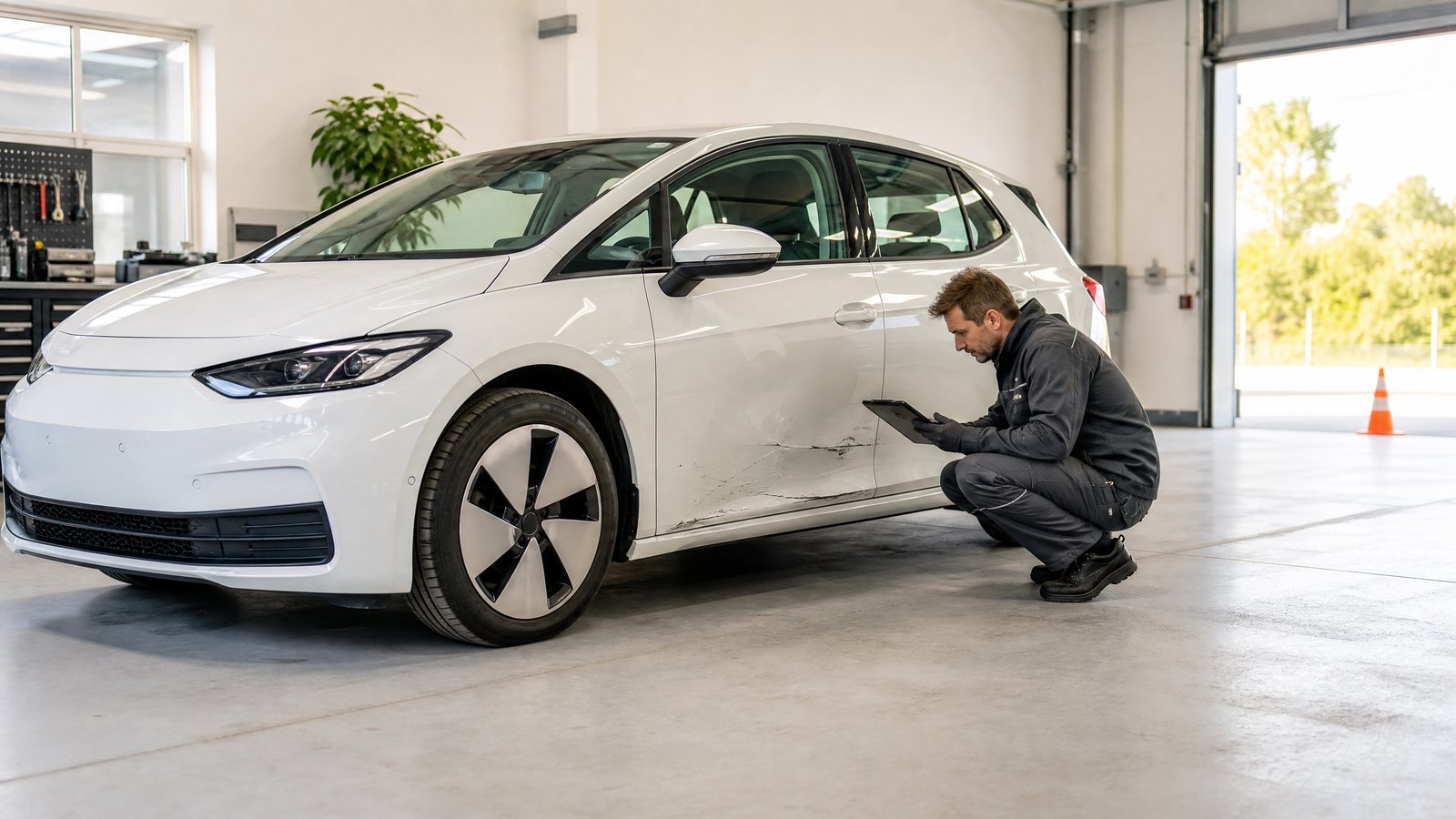
What is different in accidents with electric cars
On the outside, accident damage to an electric car often hardly differs from damage to a combustion-engine car: bumper, headlights, wings. Beneath the surface, however, there are important differences. The high-voltage battery usually occupies a large area of the underbody, high-voltage cables run through the vehicle, and many driver assistance systems rely on cameras and radar sensors. Even grounding the car on a kerb or a side impact can therefore have consequences that cannot be seen from the outside.
In addition, repairs to electric vehicles are often more expensive because special work steps, trained staff and sometimes long delivery times for components are involved. This makes a report that fully records the damage and takes the vehicle’s special features into account all the more important.
What we document on an electric car
We take a systematic approach when inspecting an electric or hybrid vehicle. In addition to the usual damage assessment, we pay attention to the areas that are particularly important for the safety and value of the vehicle:
- visible damage to the underbody, battery housing and underbody protection, as far as visible without a lift
- warning messages and fault indicators on the display, state of charge and range display
- condition of the charging port, charging flap and charging cable
- cameras, radar and ultrasonic sensors in the front, rear and wing mirrors
- signs of deformation on sills and side members that may extend to the battery area
A diagnosis of the high-voltage system itself belongs in a suitably qualified specialist garage. In the report, we clearly point out when such a test is required and take the effort into account when calculating the repair route.
Safety comes first
After an accident with an electric car, the rule is: if the vehicle shows warning messages about the high-voltage system, smells unusual, is smoking or the battery has been visibly damaged, you should not continue to use it and should keep your distance from the vehicle. Inform the breakdown or towing service that it is an electric vehicle. We will then come to where it is parked for the inspection – you do not have to move the vehicle.
Damaged electric vehicles are often parked separately by garages and towing services. This is not a problem for the inspection, but can incur additional storage costs. In an accident caused by someone else, these items are also usually part of the damage claim.

Value, loss in value and total loss for electric cars
Valuing electric cars is more demanding than for many combustion-engine cars, because the used car market is changing quickly and the condition of the battery plays a major role. In the report, we classify the replacement value on the basis of comparable offers. If the repair costs are close to the vehicle’s value, there may be an economic total loss. A mercantile loss in value can also be considered for younger vehicles if the car is regarded as an accident car after the repair.
| Area | Special feature for electric cars |
|---|---|
| Repair costs | often higher due to high-voltage work steps and special components |
| Repair time | can be longer due to delivery times – important for loss of use |
| Replacement value | depends on model, battery size and market development |
| Residual value | depends heavily on the condition of the battery |
Grounding, kerb contact and underbody damage
A frequently underestimated type of damage on electric cars is grounding: when driving over a high kerb, on a ramp or due to an object on the road. Because the battery occupies a large area of the underbody, even a dent in the housing or damaged underbody protection can be significant. Some manufacturers require an inspection after such events before the vehicle may continue to be used.
We document the visible area of the underbody with photos and describe the location and extent of the marks. Whether the battery housing is damaged or its sealing could be impaired is then clarified by a specialist garage with the appropriate equipment. In the report, this test is included in the repair route so that it is not forgotten during the settlement.
Calibration of sensors and assistance systems
Modern electric cars are almost always equipped with extensive driver assistance systems: adaptive cruise control, lane keeping assist, emergency brake assist, parking cameras. After front-end damage or a windscreen replacement, cameras and radar sensors usually have to be recalibrated. This work is not cheap and is sometimes overlooked in the calculation.
In the report, we take into account which sensors are located in the damaged area and whether calibration according to the manufacturer’s specifications is required. This ensures that the repair is complete not only visually but also technically.
These documents help with the inspection
- Vehicle registration certificate and vehicle key or key card
- Details of how the accident happened and of the other party
- Photos of the warning messages on the display, in case they have since disappeared
- Service book or digital maintenance records
- For leased vehicles, the contact details of the leasing company
- If available, information on battery condition from the manufacturer’s app
If any of these are missing, that is no reason to postpone the appointment. What matters is that the vehicle is inspected in an unrepaired state if possible.
Plug-in hybrids and full hybrids
Hybrid vehicles also have high-voltage components, albeit usually with smaller batteries. Depending on the model, the battery is located under the rear seat, in the boot floor or in the centre tunnel. It can therefore also be affected by rear-end damage or side impacts. During the inspection, we take into account where the high-voltage components of the respective model are installed and point out any necessary tests.
The same applies to the settlement as for purely electric cars: repair costs, repair time, loss in value and, where applicable, replacement and residual value are recorded in the report. In the case of an accident that was not your fault, the other party’s insurer usually bears the costs.
Damage related to charging
Not all damage to an electric car occurs in moving traffic. Bumps at public charging stations, damaged charging flaps, torn-off charging cables or damage caused by vandalism in car parks also occur. Clean documentation is important here too, especially if the person responsible is unknown. Photograph the charging station, the parking space and your vehicle and report the damage to the operator. If the person responsible is unknown, evidence preservation helps to record traces before they are lost.
Settlement after an accident that was not your fault
If someone else caused the accident, you are usually entitled to commission an independent expert of your choice, and the other party’s insurer bears the appraisal costs. This is particularly worthwhile for electric cars, because insurers look closely at high repair costs. A complete accident report with a transparent justification of the repair route reduces queries. Further background on costs can be found on the costs & prices page.
Electric car appraisals in Berlin and Brandenburg
We inspect electric and hybrid vehicles throughout Berlin, for example in Pankow or Steglitz, and in the surrounding Brandenburg area. As a car appraiser for Berlin & Brandenburg, we come to you free of charge and offer appointments as quickly as possible.

Battery condition and value: why high-voltage battery documents matter
With an electric car, a large part of the vehicle’s value depends on the high-voltage battery. After an accident, the question is therefore not only about visible damage, but also whether the battery has been affected. Scratch marks on the underbody, deformed protective plates or error messages on the display are warning signs that we record.
If you have documents on the battery condition, such as a certificate from the garage or readout data from the manufacturer, we include them in the documentation. They help to classify the replacement value and to decide whether further testing at a brand-authorised specialist garage makes sense. Without such evidence, the valuation remains more cautious, and this can be noticeable in the settlement.
Towing and parking a damaged electric car
A damaged electric car should not be treated like a combustion-engine car after an accident. Many manufacturers specify how the vehicle may be towed, often only with the drive wheels raised or on a flatbed. After a heavier impact, an electric car is initially parked at a distance from other vehicles at some storage sites until it is clear that the high-voltage battery has not been damaged.
For the electric car appraisal in Berlin, it is helpful to know where the vehicle is and how it got there. Please also let us know whether warning messages appeared on the display. We read out the control units and document the fault memory entries before the vehicle is moved further or repaired.
FAQ – Frequently Asked Questions
Does an electric car need a special report after an accident?
The structure is similar to any accident report. In addition, there are the special features of the electric drive, such as possible damage to the battery housing, high-voltage cables or sensors. We take these points into account during the inspection.
Do you also check the high-voltage battery?
We document visible damage and warning messages. A technical diagnosis of the high-voltage system is carried out at a suitably qualified specialist garage. In the report, we point out when such a test is necessary.
May I continue driving my electric car after an accident?
Only if no warning messages appear, no parts are loose and there is no suspicion of battery damage. If in doubt, have the vehicle towed.
Is repairing an electric car more expensive?
Often yes, because special work steps and trained staff are required. Delivery times for components can also extend the repair time.
Who pays for the report?
In the case of an accident that was not your fault, it is usually the liability insurer of the party who caused it, provided the damage is above the minor damage threshold.
Does this also apply to hybrid vehicles?
Yes. Plug-in hybrids and full hybrids also have high-voltage components, which we pay attention to during the inspection.
Do you come to the towing service?
Yes. We come free of charge to wherever the vehicle is, including the towing service or the garage.
Do you need fast, professional help?
We work for you in Berlin and Brandenburg and come to you free of charge. We offer appointments as quickly as possible.