Vehicle Evidence Preservation Berlin – Documenting Traces and Damage Reliably
Vehicle evidence preservation in Berlin records the condition of your vehicle before traces are lost through repair, sale, scrapping or weather. We work on a mobile basis in Berlin and Brandenburg, the call-out is free of charge, and we offer appointments as quickly as possible, because every day counts when preserving evidence.
In short: Evidence preservation makes sense after a hit-and-run, in a dispute about a repair, before an accident car is scrapped or when court proceedings are likely. We document the VIN, mileage, damage pattern and measurements with date and location. Compact documentation costs from 150 € to 350 €, extensive documentation from 300 € to 700 €. General information on evidence is available on Wikipedia.
Table of contents
- Quick condition recording before repair or handover
- Unaltered condition: identification features and mileage
- Meaningful photo documentation and digital archiving
- Areas of use, typical occasions and the factual limits of the findings
- Preserving evidence after a faulty repair
- Frequently asked questions about the service
- Vehicle evidence preservation in Berlin: securing evidence before traces change
- Documentation for workshop, insurer and possible queries
Quick condition recording before repair or handover
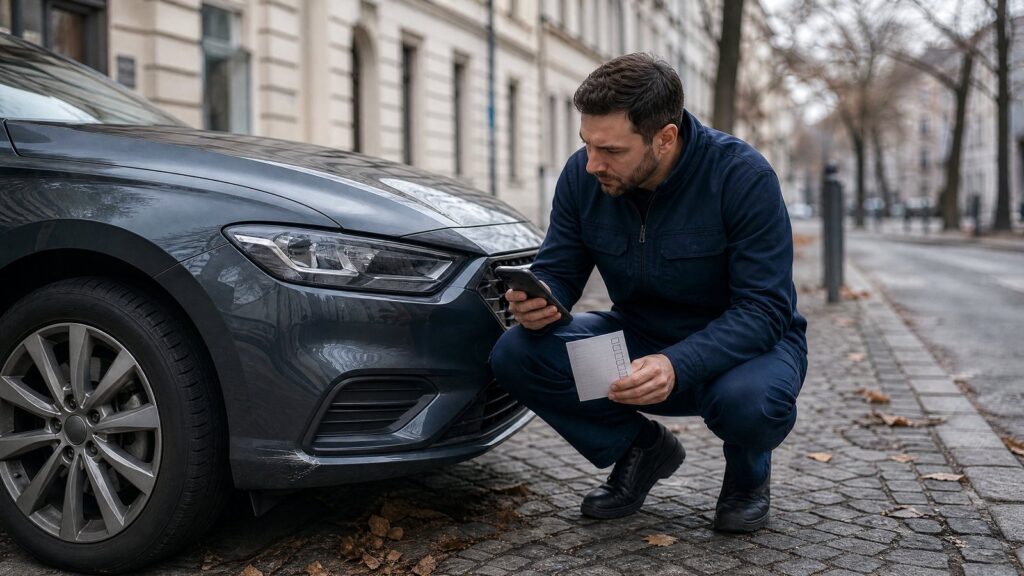
When measures are time-critical, it is important to record the condition of the vehicle neutrally as early as possible. Prompt evidence preservation reduces the risk of relevant traces being lost through transport, cleaning or initial repair work. We document visible damage, material detachment, loss of dimensional accuracy and other abnormalities in words and pictures so that it remains traceable later what condition existed immediately before the work. The description is objective and reproducible, without speculating about causes or responsibilities. This documentation can later serve as the basis for a detailed damage report or a comprehensive accident report.
You can find out more about our work as a car appraiser for Berlin & Brandenburg on our home page.
For you, this means that the documentation is prepared in such a way that it can be checked by third parties. Photos and notes follow common inspection standards and include the date and time they were taken. If you wish, photos are taken in a sequence and with dimensions that make later comparisons easier. The aim is a reliable, neutral record of the condition that serves as the basis for further steps if in doubt, without making any legal assessments. This is particularly important for professional damage documentation for claim settlement, which is often supplemented by an on-site inspection.
Unaltered condition: identification features and mileage
Unique identification features such as the chassis number and the documented mileage are particularly important. These data are recorded together with positions and visible signs of ageing or damage to enable the vehicle to be identified unambiguously. The record is made in such a way that subsequent tampering or mix-ups can be ruled out. Every detail is logged traceably, including where the reading was taken and any plausibility features.
In addition, old damage and fresh traces are distinguished as far as this is possible from the visible condition, without asserting causal connections. Typical inspection points during the recording include:
- Chassis number: legibility, position and several photo views to ensure identity.
- Mileage: photos of the display, comparison with existing documents and noted reading direction.
- Visible body and paint damage: location, extent, presumed depth and adjacent deformations.
- Interior and attached parts: condition of seats, seat belts, airbag markings and sensors.

Meaningful photo documentation and digital archiving
Photographic records are the heart of evidence preservation. Systematically taken photos from defined perspectives, with scales and additional close-ups, make it possible to compare traces of damage later. In addition to images, metadata such as the date, time and camera angle are documented. We archive the files digitally in common formats and structure them so that individual image sequences can be assigned to specific inspection positions. This keeps it traceable how the visual evidence came about.
The structured filing of the digital documents makes it easier to pass them on to assessors, workshops or other parties involved, if you so wish. Below is a compact overview of typical inspection aspects, what we look at and the practical benefit of each type of documentation.
| Inspection aspect | What we look at | Benefit of the documentation |
|---|---|---|
| Photo series | Wide shot showing the location, close-ups with scale | Comparability before and after work, clear visualisation |
| Metadata | Date, time, GPS reference if applicable and file naming convention | Traceability of the recording conditions |
| Identification data | Chassis number, registration number, mileage | Unambiguous assignment of the vehicle to the photos |
| Damage description | Location, extent, visible material damage | Basis for technical assessments and comparative findings |
Areas of use, typical occasions and the factual limits of the findings
Evidence preservation is suitable for various occasions: vehicle handovers on sale or lease return, documentation before major repairs or before scrapping, and as a precaution when disputes are looming. In such situations, a neutral and prompt inventory creates clarity about existing defects and unclear previous damage. The documented information serves as a basis for further decisions, comparisons or technical assessments without already making a legal assessment. We operate in various districts, including as a car appraiser in Pankow, Zehlendorf and Wilmersdorf.
It is important to present the limits of the findings transparently: objective findings can be derived from the condition record, but not necessarily reliable statements about the cause of damage or the question of liability. Nor does the documentation automatically replace later formal taking of evidence by the competent authorities. It provides an objective, reproducible basis that can be used accordingly in consultation with you. Further information on costs and prices and helpful tips can be found in our vehicle appraisal guide (German).
Vehicle evidence preservation in Berlin: securing evidence before traces change
After an accident, damage in a car park or an unclear repair, time is often a decisive factor. Vehicles are moved, cleaned or repaired, and in the process traces, positions and details can be lost. Prompt evidence preservation therefore documents the overview, close-ups, affected components and recognisable connections in a traceable sequence.
What matters is not just the number of photos but their significance. Viewing angle, scale, assignment to the vehicle and a clear description help to classify the findings later without having to rely on memory alone.
Documentation for workshop, insurer and possible queries
Well-prepared documentation can support workshops in their technical assessment and give the insurer an understandable basis. It separates visible traces from assumptions, names the documents available and explains which points may still need to be checked.
A structured sequence pays off especially when queries arise later. It makes it possible to find individual findings, photos and details quickly and relate them objectively to the question at hand.
Preserving evidence after a faulty repair
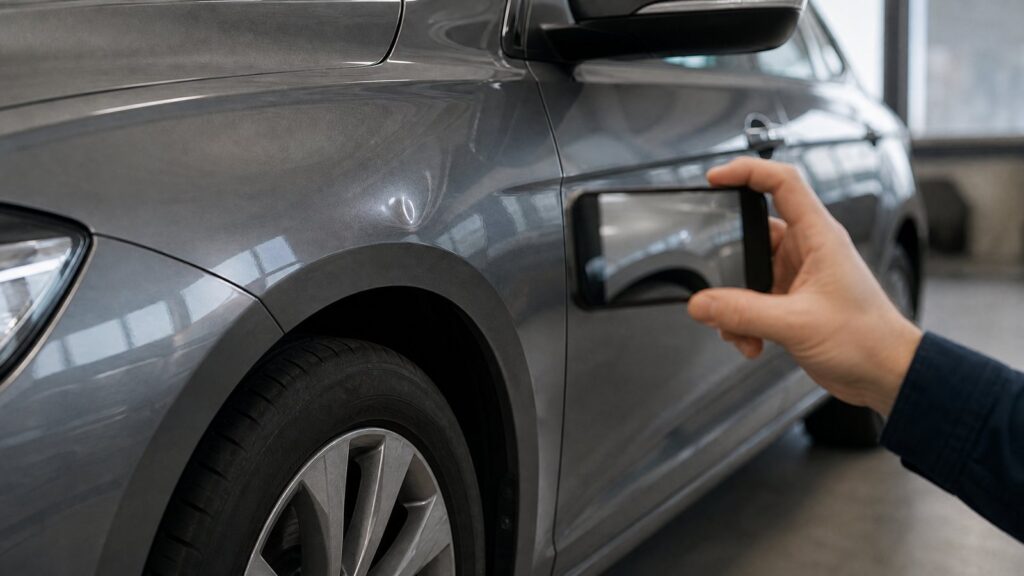
Not every case of evidence preservation has to do with an accident. Vehicle owners often contact us when something is not right after a repair: the colour does not match, panel gaps are uneven, a warning light no longer goes out or there is a new noise. Before the vehicle goes back to the workshop or another business carries out rectification work, the condition should be recorded. Otherwise it will hardly be possible to show later what the original work looked like.
In such cases, as part of vehicle evidence preservation in Berlin, we document the affected components with overview and detail photos, measure paint layer thicknesses and, if necessary, read out the fault memories of the control units. Where it is necessary to look into cavities, we use an endoscope without dismantling anything. Everything is linked to the date, mileage and chassis number.
It is important to understand what evidence preservation can and cannot do. We record the condition and describe what can be seen technically. Whether this gives rise to a claim against the workshop is a legal question that you should clarify with your lawyer. Our documentation gives your lawyer an objective basis for this.
It is best to contact us before anyone does any further work on the vehicle. Bring the invoice for the first repair, your correspondence with the workshop and your own photos. The more complete the documents, the more clearly the condition can be classified later.
FAQ – Frequently Asked Questions
When should evidence preservation ideally be carried out?
Ideally, the condition is recorded before any measures that could change it, i.e. before repairs, before returning the vehicle to a lessor or before a sale. It is crucial that no preparatory cleaning or repair work takes place beforehand so that all relevant traces are visible. Coordinating early helps to align the time of recording with your interests.
Which documents and data do I need for evidence preservation?
The basics are the vehicle documents, the key and information on previous damage reports, if any. Photos of earlier conditions or maintenance records are also useful if you would like to include them. However, the evidence preservation itself primarily comprises the current physical and visual examination of the vehicle, supplemented by recording identification features and mileage.
Do you reliably identify old damage during evidence preservation?
The examination documents visible features and can provide indications of ageing or existing damage. Whether damage can be clearly classified as new or old depends on the nature of the traces and the comparative information available. In the findings, we point out typical features in a traceable manner without asserting causes, and state which findings can be directly proven.
In what format will I receive the documents?
The documentation is handed over digitally in common image and text formats and filed in a structured way so that individual inspection positions are easy to find. Metadata are retained so that time stamps and recording conditions remain traceable. On request, we provide the files in a clear folder structure so that they can be used for further evaluations or checks by third parties.
Do you only photograph damage on site, or do you also take measurements?
In addition to the visual documentation, we carry out simple measurements of size or depth where necessary and useful, and record them in writing. More extensive measurement examinations are possible if agreed. The type and depth of the examination depend on your purpose and on the extent to which additional measurements improve traceability.
How long are the digital documents available and how are they handled?
The documents are compiled in a structured digital file and handed over to you once the work is complete. We document the technical metadata and back up the files before handover. How long you keep the documents is up to you; they are only passed on to authorised third parties with your approval. If you have any questions about the evaluation, we are available to explain.
Do you need fast, professional help?
We operate throughout Berlin and Brandenburg. Contact us for a free initial assessment.